Guides · Sep 17, 2026 · Editorial team
WebP vs JPG: Which Image Format Is Best for Your Website?
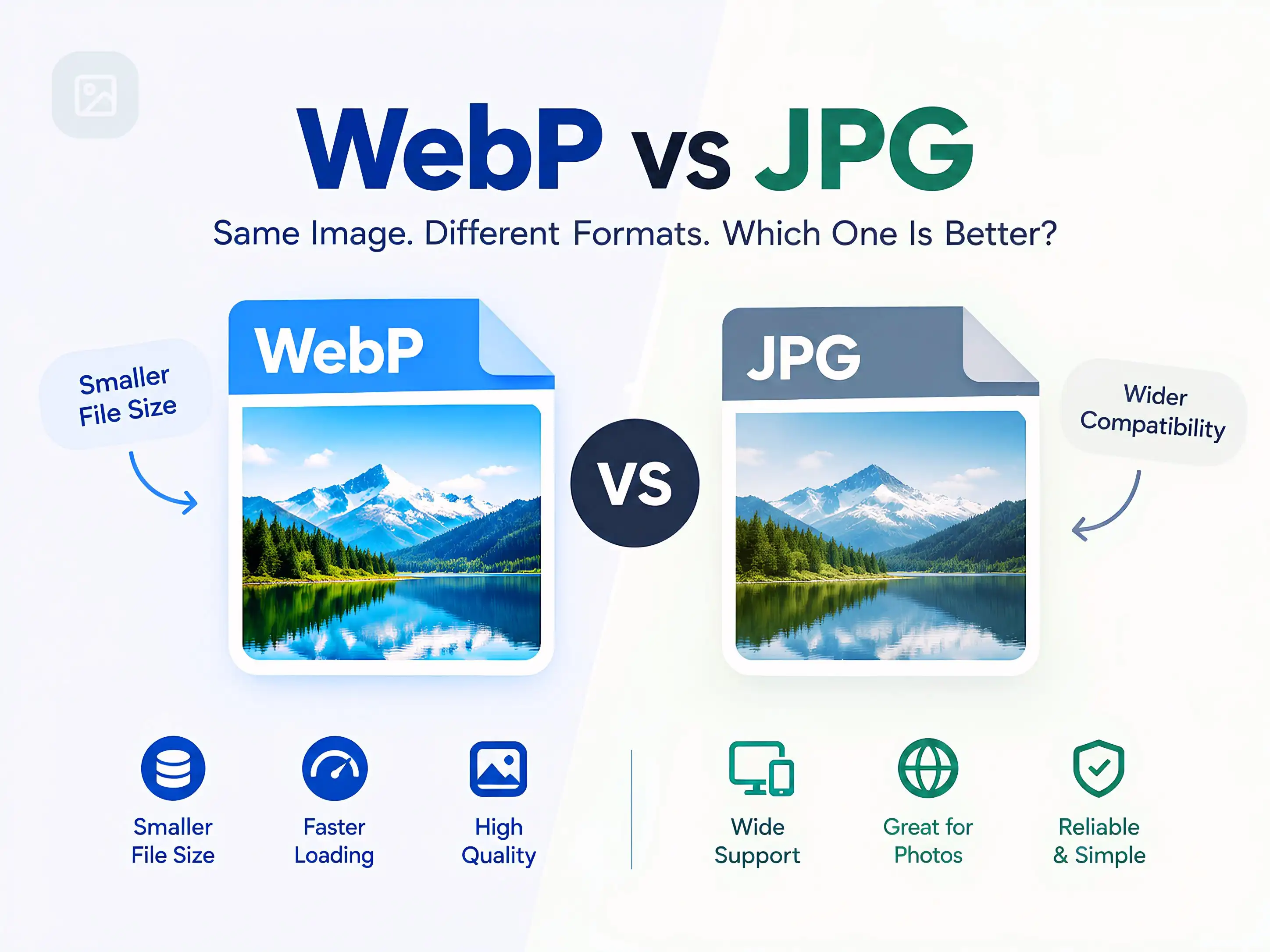
File types have an immense effect on the overall performance of the website, on its storage, and even on the user’s experience. Deciding whether to use WebP or JPG influences the speed of the webpage loading and quality of the images on different devices. Although JPG was the standard type of digital image file for many years, WebP appeared as a newer type tailored for web optimization.
Knowledge of the differences between WebP and JPG will allow the website owners to make their webpages lighter without losing their clarity. This article explains file size efficiency, image quality, transparency, browser support, and SEO performance of both types of files.
What Is JPG?
JPG (JPEG, an acronym for Joint Photographic Experts Group) is a common digital image format launched in 1992. The JPG file format employs lossy compression that shrinks file size by eliminating imperceptible details regarding colors in the picture.
JPG files are the standard output from digital cameras, cell phones, and graphic software. The primary strength of the file type is its ubiquitous compatibility in all operating systems, browsers, and media programs. The downside of the file type is that it does not allow transparency or animations.
What Is WebP?
WebP means Web Picture format. This image format was created by Google in 2010 and is meant to be used in order to speed up the process of loading of webpages due to reduced file size with the same visual quality.
This format is unique from the JPG format since it is capable of supporting lossy and lossless compression, transparency, and animation. In other words, WebP unites the main characteristics of JPG, PNG, and GIF formats.
WebP vs JPG: Key Feature Comparison
WebP vs. JPG File Size and Compression
The major advantage that WebP has over JPG is file size effectiveness. WebP makes use of complex predictive coding algorithms to compress images. Predicting pixel values using neighboring blocks, WebP only saves the difference values instead of the actual image.
This way WebP can save image files, which are about 25 to 34 percent smaller in comparison to JPG files with the same visual quality scores. The smaller files will mean lower bandwidth usage and faster downloads.
WebP vs. JPG Quality: Is WebP Better Quality Than JPEG?
In terms of WebP and JPG comparison, there is no winner based solely on image quality. The image quality itself depends on the compression rate chosen for both images. At equal file size, WebP offers much higher clarity of the image compared to JPG with less blur and visual distortions.
The problem with JPG is that heavy compression may lead to noticeable blocking patterns and color bleed at high-contrast edges. WebP deals with this effect much better. Nevertheless, for photo editing purposes and for storing master photos, uncompressed JPG and specialized photographic files are still used.
WebP vs. JPG Transparency
The first difference between WebP and JPG is transparency.
There is no way for JPG to allow for transparency because any logo or other transparent file that is saved in this format becomes either black or white colored.
In WebP, full transparency is possible due to the 8-bit channels, making WebP files even smaller than those of PNG format.
WebP vs. JPG Browser Support and Compatibility
Compatibility of WebP is high in today’s browsers, which support more than 96% of worldwide web traffic, such as Google Chrome, Safari, Firefox, Microsoft Edge, and Opera.
However, compatibility is still a concern:
Web Browsers: Most modern web browsers support WebP without any problem. However, old versions of browsers (like Internet Explorer) cannot support WebP natively without using additional code.
Offline Applications: Some old software applications, viewers, and offline photo editors cannot open downloaded WebP images.
Photo Editing Workflow: Many photo editing tools require plugins or new builds to import and export WebP images natively.
WebP vs. JPG SEO Impact
Image format choice directly influences search engine optimization (SEO). Google uses page speed and Core Web Vitals as key ranking factors. Because WebP reduces total page weight, pages load faster, lowering bounce rates and improving user retention.
Search engine crawlers index WebP images just as effectively as JPG files. Using WebP helps meet performance benchmarks recommended by Google PageSpeed Insights, giving websites a competitive technical advantage in search engine results pages. Professional design implementations, like those created by a website designer, routinely leverage WebP conversion to maintain balance between layout design and speed metrics.
What Are the Disadvantages of Using WebP?
Despite the benefits of WebP in web usage, there are some disadvantages associated with it, which include:
Support for Legacy Programs: Older programs used for viewing images may not be able to view and even upload the image in WebP format.
Server Overload: The process of converting high amounts of images into WebP format needs CPU processing.
Strict Formats: Certain professional publications require images in only specific formats like JPG, TIFF, or PSD.
When to Use Each Format
Use WebP for:
E-commerce product galleries and hero banners.
Blog post illustrations and inline graphics.
Logos and graphics requiring transparent backgrounds.
Maximizing site speed and technical SEO scores, often guided by a specialized SEO expert in Nepal.
Use JPG for:
Digital camera photos and master storage archives.
Images intended for print media production.
Situations where legacy system compatibility is mandatory.
Email marketing templates with strict client rendering rules.
How to Convert Between WebP and JPG
Switching formats allows you to balance web speed with editing requirements. If you download a WebP file that needs editing in older software, converting it to JPG restores broad compatibility. Conversely, converting existing JPG libraries to WebP immediately speeds up page loading times.
You can instantly switch file formats using our free web conversion tool:
To convert WebP files for offline software use, visit the WebP to JPG Converter.
To convert existing media libraries for faster web loading, use our main Image Conversion Tool.
For detailed instructions on optimizing media assets across different content management systems, check out our guide section on How Conversion Works or browse more site optimization tips on our Tech Blog. Additional technical insights and professional resources are available through this online profile.
Frequently Asked Questions
WebP vs. JPG: Is the WebP format better for websites?
Yes. The WebP format offers a file size up to 25%-34% smaller than JPG format when visual quality is the same.
Why should you choose the WebP format instead of JPG?
You should prefer the WebP format over the JPG one, as it will allow you to save page load time, cut bandwidth usage, use transparency, and improve Core Web Vitals for higher SEO ranking.
Is it possible for any browser to display WebP images?
Most of the modern browsers support WebP images, including Google Chrome, Firefox, Safari, Opera, and Edge. They work perfectly for over 96% of internet users. Fallback is required for older browsers such as Internet Explorer.
Does converting JPG to WebP damage image quality?
Converting JPG to WebP using adequate compression will not affect the quality but make your files much smaller.
How can I turn my downloaded WebP into a JPG?
There are many ways to do that, including an online file converter, graphic software, and special browser extensions.
Conclusion
The debate about WebP vs. JPG is all about context. The better option for today's web publishing purposes would be WebP due to its smaller file sizes, high-quality visuals, transparency, and faster loading pages, which improve SEO. However, JPG is still great for offline use and printing needs.
WebP is an excellent choice for webmasters who want to improve their site loading times. For those who require offline compatibility, it is easy to convert images via special converters.